



There are certain things you can’t unsee once you’ve worked in IT long enough.
I can watch an action movie and completely accept the hero jumping from a moving helicopter onto a train.
No problem.
But let somebody walk up to a computer, type three commands, announce “I’m in,” and suddenly I have questions.
Working in IT changes the way you watch movies and television. While everyone else is following the plot, some of us are looking at the computer sitting on the desk, wondering why nobody has locked their screen or trying to figure out how a hacker apparently downloaded an entire database in four seconds.
So, in the spirit of having a little fun, here are some of the things IT people notice in movies that everyone else seems perfectly willing to ignore.
1. Apparently, Every Password Can Be Guessed in Three Tries
The detective sits down at someone’s computer.
Password prompt.
They look around the room.
There’s a photograph of a dog.
“What’s the dog’s name?”
“Max.”
They type:
MAX
ACCESS GRANTED.
Meanwhile, somewhere, an IT person is staring at the television in disbelief.
In the real world, passwords are rarely that cooperative. And if your company password actually is the name of the dog whose picture is sitting next to your monitor, we should probably have a conversation.
The movie version gets even better when someone has exactly three attempts to guess a password before something catastrophic happens.
First try: birthday.
Wrong.
Second try: daughter’s name.
Wrong.
Then the dramatic music starts.
The character stares at a photograph.
Suddenly…
“Of course.”
They type one final password.
They’re in.
If only password resets were always that exciting.
2. Nobody Ever Locks Their Computer
Movie characters have an incredible amount of trust.
They’ll be working with classified information, financial records, criminal evidence or the secret plans for whatever giant machine is about to destroy the world.
Then someone calls their name.
They stand up…
…and walk away.
Computer completely unlocked.
Sometimes they leave the building.
If you work in IT or cybersecurity, you’re probably no longer paying attention to the conversation happening on screen.
You’re looking at the abandoned workstation.
Lock your computer.
Windows key + L.
It takes about a second.
This may be the least exciting cybersecurity advice you’ll ever receive, but unlike a lot of movie hacking, it actually works.
3. Movie Hackers Type Really, Really Fast
You know the scene.
Dark room.
Multiple monitors.
Hoodie optional.
The hacker begins furiously typing.
Windows start flying across the screen. Code scrolls everywhere. Maps appear. Satellites move. IP addresses flash. A progress bar starts filling.
Nobody uses a mouse.
Ever.
Then comes the announcement:
“I’m bypassing the firewall.”
More typing.
“Almost there.”
More typing.
“I’m in.”
Total elapsed time: approximately 14 seconds.
Real IT work often looks considerably less impressive.
Sometimes it’s one person staring at a log for 20 minutes and saying:
“That’s weird.”
Then opening another log.
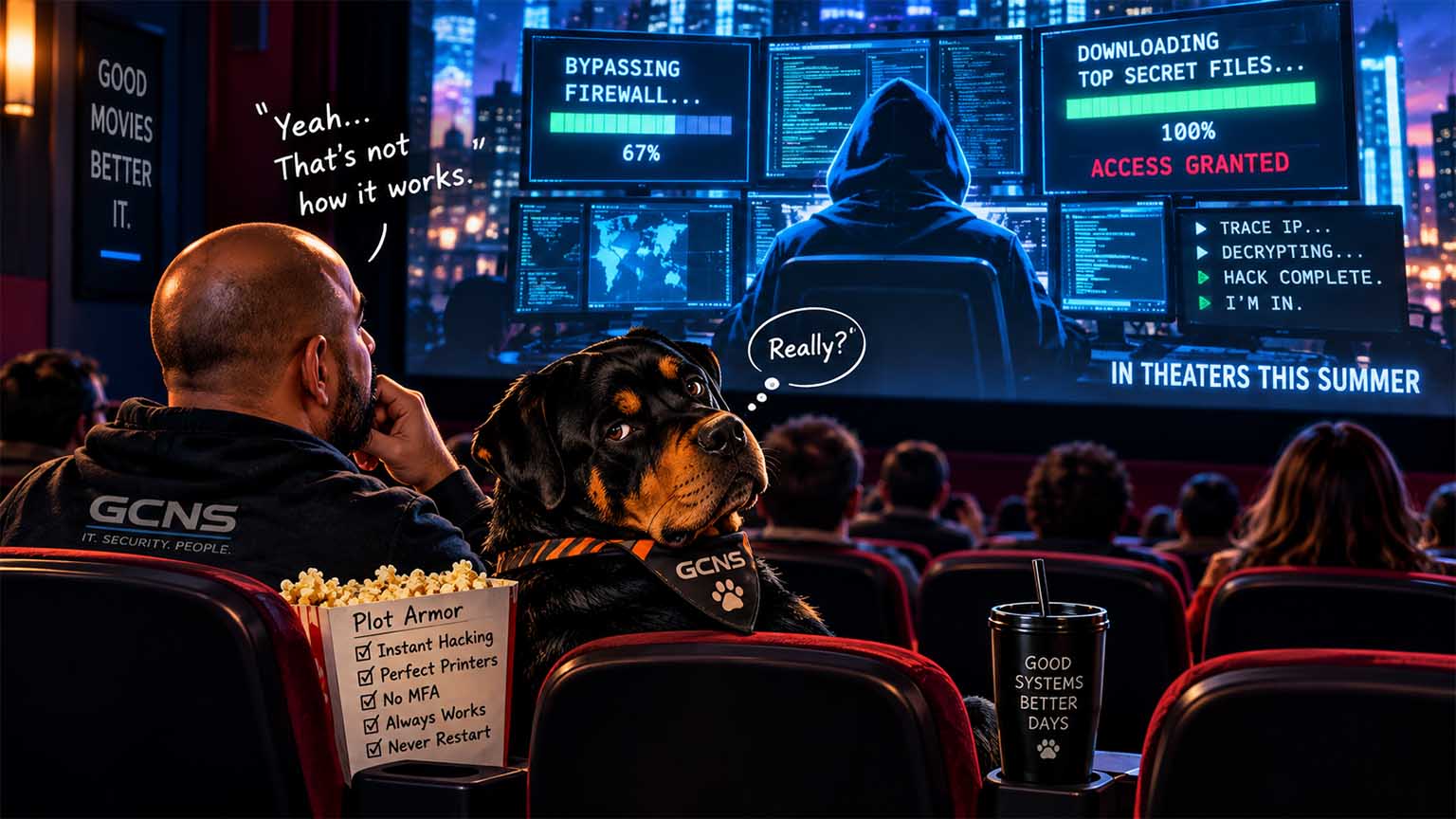
4. Progress Bars in Movies Are Surprisingly Honest
This may be the least realistic technology in Hollywood.
Someone is downloading highly sensitive information while security guards race toward the room.
The screen says:
42%
Footsteps get closer.
67%
Security is coming up the elevator.
91%
Someone starts yelling, “Come on! Come on!”
99%
And somehow the progress bar reaches 100% exactly one second before the guards enter.
Anyone who has ever watched a Windows update sit at the same percentage for what feels like an eternity knows computers don’t respect dramatic timing.
A real movie progress bar would get to 96%, stop moving and say:
“Approximately 4 minutes remaining.”
Twenty minutes later:
“Approximately 11 minutes remaining.”
Now that’s suspense.
5. Every Computer Makes a Sound When Something Appears on the Screen
Movies apparently purchase computers from a completely different manufacturer than the rest of us.
Open a window?
Beep.
Zoom into an image?
Bloop.
New email?
Beep-beep.
Security camera selected?
Brrrrp.
Facial recognition?
Approximately 37 electronic noises while boxes rapidly scan every face in the database.
If real business computers made that much noise, the first help desk ticket of the morning would be:
“Please make it stop.”
6. “Enhance” Can Apparently Create Information That Doesn’t Exist
A detective pulls up a grainy security-camera image.
The suspect is 200 feet away.
At night.
In the rain.
Facing the opposite direction.
Someone says:
“Enhance.”
Click.
Suddenly we can read the reflection of a license plate in the suspect’s sunglasses.
Technology has become remarkably good at improving images, and AI has pushed those capabilities even further.
But there’s an important distinction between enhancing information that was captured and inventing information that wasn’t.
You can’t reliably recover unlimited real-world detail from pixels that were never recorded in the first place.
Hollywood remains unconcerned by this limitation.
7. Nobody Has Multi-Factor Authentication
The villain steals someone’s password.
That’s it.
They now control everything.
Email.
Bank accounts.
Corporate network.
Secret government database.
Possibly a satellite.
Nobody gets an authentication prompt.
Nobody gets a security-key request.
Nobody receives a notification asking whether they’re trying to sign in from a computer in another country.
Nobody from IT says:
“I disabled the account.”
The password is apparently the single key to civilization.
Real organizations aren’t always perfect about MFA either, but there’s a reason cybersecurity professionals keep recommending it.
A stolen password shouldn’t automatically mean a stolen account.
8. USB Drives Are Treated Like They’re Completely Harmless
Someone finds a mysterious USB drive.
What do they do?
Naturally, they plug it directly into the most important computer in the building.
No hesitation.
No scanning.
No isolated system.
Just:
Let’s see what’s on this thing.
Every IT person watching immediately becomes uncomfortable.
If you find an unknown USB device in the parking lot, conference room or lobby, plugging it into your work computer should not be your first move.
Although, admittedly:
“Character hands USB drive to IT department for proper examination”
probably doesn’t sell many movie tickets.
9. Nobody Ever Has to Restart
The computer starts behaving strangely.
The application freezes.
The network connection drops.
Some complicated system stops responding.
Yet nobody says:
“Have you restarted it?”
Maybe Hollywood knows that scene would hit too close to home.
In the real world, restarting a computer can clear temporary problems, reload services and drivers, complete updates and provide useful information during troubleshooting.
It’s not magic.
It just occasionally feels like it.
And yes, IT is probably going to ask.
10. IT Always Knows the Answer Immediately
This one may be my favorite.
Something breaks.
Everyone turns toward the IT person.
They glance at the screen for approximately two seconds.
“It’s a DNS attack routed through the secondary firewall.”
Problem identified.
No troubleshooting.
No logs.
No testing.
No asking what changed.
No Googling an obscure error message.
No vendor documentation.
No:
“That’s strange. Give me a minute.”
Real IT troubleshooting is much more methodical.
You gather information.
You reproduce the problem.
You eliminate possibilities.
You check logs.
You test a theory.
Sometimes the first theory is right.
Sometimes the fifth one is.
Good IT isn’t about magically knowing every answer.
It’s about knowing how to find the answer.
Real IT Isn’t Quite as Cinematic & That’s Probably a Good Thing
Movies need technology to move the story forward.
Nobody wants to watch a 20-minute scene where the hero waits for Microsoft 365 changes to propagate.
And a realistic ransomware recovery probably isn’t improved by a dramatic countdown clock covering the entire screen.
So I’m willing to forgive Hollywood.
Mostly.
But after enough years working in technology, certain things become impossible not to notice.
The unlocked computers.
The mystery USB drives.
The magical passwords.
The perfectly timed downloads.
The hacker who apparently types 180 words per minute without making a mistake.
And, of course, the printer that works on the first try.
That one may be taking things a little too far.
At GC Network Solutions, the technology problems we deal with aren’t usually quite as cinematic. They’re real business problems involving cybersecurity, networks, Microsoft 365, backups, computers, email and the occasional printer that has decided it no longer wants to participate.
Our job isn’t to dramatically announce:
“I’m in.”
It’s to keep your technology working, your business protected and ideally prevent the dramatic part from happening in the first place.
And yes…
we may ask you to restart.