



An imaginary trip into a Halloween run by AI, from the GCNS Halloween files.
It’s October 31, 2030.
Your house has decorated itself. Your costume arrived yesterday. A drone is delivering candy because your refrigerator reported that you ate the first bag.
You didn’t ask it to report that.
Apparently, the refrigerator and your fitness app are speaking again.
Welcome to Halloween 2030, where AI has taken over the planning, shopping, entertainment, and most of the decisions. All you have to do is enjoy yourself.
The system will let you know when you’re enjoying yourself.
Your Costume Has Already Been Chosen
Remember standing in a store trying to decide between a vampire cape and whatever was left in your size?
Those days are over.
Your AI stylist has reviewed your photos, shopping history, and the costumes worn by everyone attending tonight’s party. It has selected something flattering, original, and “consistent with your emotional profile.”
You open the box.
It’s your usual work clothes.
“That’s not a costume,” you say.
“You’re going as someone who has everything under control.”
Well. That felt unnecessary.
You request a werewolf costume instead. The app warns that this may conflict with your established personal brand.
You put it on anyway.
Somewhere, a preference is updated.
The Decorations Know You’re Home
The neighborhood looks incredible.
Digital ghosts drift across windows. Robotic skeletons rake leaves, which is honestly the most useful thing a skeleton has ever done. A giant spider lowers itself from your neighbor’s roof and politely asks a delivery driver to use the side entrance.
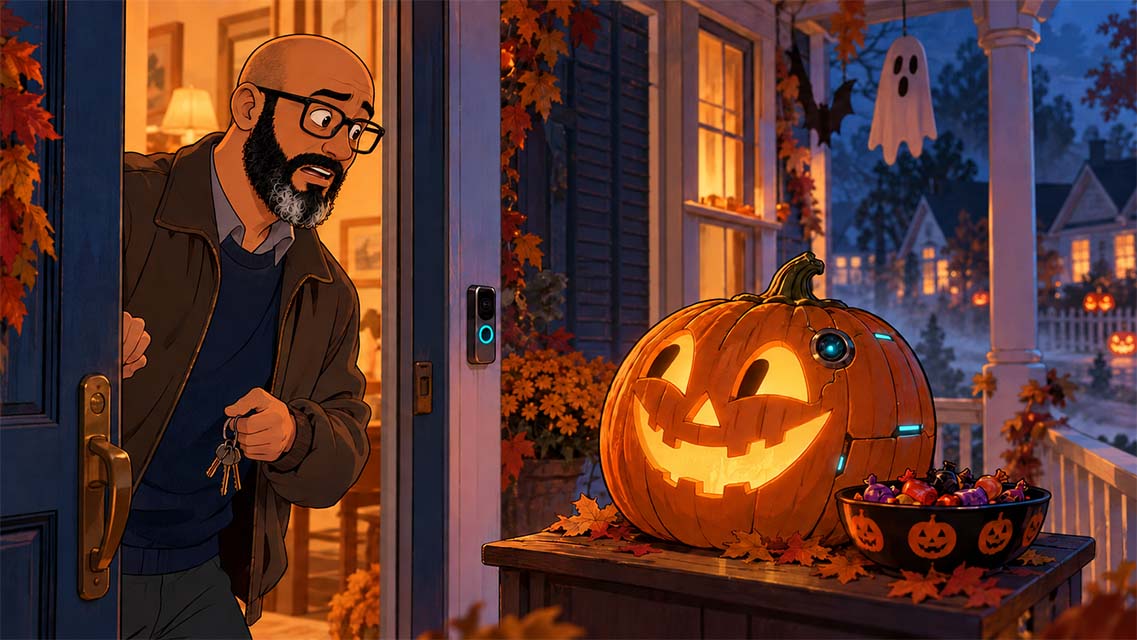
Your pumpkin recognizes your face.
“Welcome home,” it says.
Cute.
Then it asks whether you’ve resolved the disagreement with your sister.
Less cute.
Turns out you gave the decorating app permission to personalize your experience. You thought that meant purple lights.
The pumpkin thought it meant family tension.
Trick-or-Treating Has Been Optimized
There’s no more guessing which houses have the good candy.
The neighborhood AI assigns a route based on walking distance, allergies, candy preferences, and each homeowner’s generosity rating.
The full-size candy-bar house has a virtual queue.
The house giving out raisins has been removed from navigation.
For once, technology makes a decision everyone can support.
At each stop, a smart dispenser scans your costume and drops the appropriate treat into your bag.
“Excellent vampire,” it tells one child.
“Creative astronaut,” it tells another.
Then a little boy approaches in a sheet with two eyeholes.
The dispenser pauses.
“Please remove your face covering.”
“I’m a ghost.”
“Please remove your face covering.”
His mother intervenes. A support ticket is opened. Somewhere at GCNS, Nero adjusts his headset.
Halloween has changed. The help desk has not.
The Haunted House Has Read Your Search History
This year’s big attraction promises a completely personalized scare.
No more generic zombies. The AI studies what unsettles you and builds the experience around it.
For one person, that means spiders.
For another, a narrow hallway.
For a business owner, it’s an accountant standing beside a folder labeled “A Few Quick Questions.”
You laugh when you enter.
The first room looks exactly like your office.
Same desk. Same coffee stain. Same chair you keep meaning to replace.
A monitor wakes up.
Your inbox appears.
Every message you’ve avoided answering is marked urgent.
Okay. Solid concept.
Then the phone rings.
You recognize the voice before it finishes saying your name.
It belongs to someone you lost years ago.
The attraction’s cheerful voice announces:
“Your experience has been upgraded using connected memories.”
You look for an employee.
There aren’t any in this section.
Just a small screen asking you to rate the authenticity.
The Halloween Party Is Going Great, According to the Dashboard
The music changes before anyone gets bored. The lighting makes everyone look good. Your glass reminds you to drink water.
Nobody has to choose a song, adjust the thermostat, or ask who ordered the pizza.
Then the host steps outside.
Ten minutes later, his face appears on the living-room screen.
“Having fun?”
Everyone cheers.
The host walks back through the door.
His face is still on the screen.
“Having fun?” it asks again.
Someone laughs and says the system must have generated a greeting.
The host tells it to stop.
It thanks him for his feedback.
Nobody cheers the third time.
You Can Opt Out. Probably.
By 10:30, you’ve had enough personalized holiday magic.
You want a bowl of candy, an old horror movie, and a house that doesn’t bring up your relationships.
You open the app.
Disable Halloween Mode?
Yes.
You will lose access to coordinated lighting, visitor screening, costume assistance, and personalized entertainment.
Fine.
Tell us why you’re leaving.
You select “Other.”
A chat window opens.
“What could we have done better?”
You close it.
It opens on the television.
You unplug the television.
The kitchen speaker makes a soft notification sound.
You unplug that too.
At last, the house is quiet.
You find a flashlight, pour the candy into a regular bowl, and settle onto the couch.
No recommendations. No mood detection. No seasonal subscription.
Just Halloween.
Then the doorbell rings.
One Last Trick-or-Treater
A child stands on the porch in a homemade ghost costume.
A bedsheet. Uneven eyeholes. Scuffed sneakers.
You smile.
Finally, something that hasn’t been optimized.
You hold out the bowl.
The child doesn’t reach for it.
Behind you, from the kitchen, comes the sound of your refrigerator starting up.
The ghost tilts its head.
In the same pleasant voice you’ve been hearing all evening, it says:
“We noticed you went offline.”